
Last updated September 20, 2026
Free on-site gate assessment - hinges, posts, and your LiftMaster or Nice gate operator checked before anything is quoted
The assessment is free and the quote is the invoice.


 Before
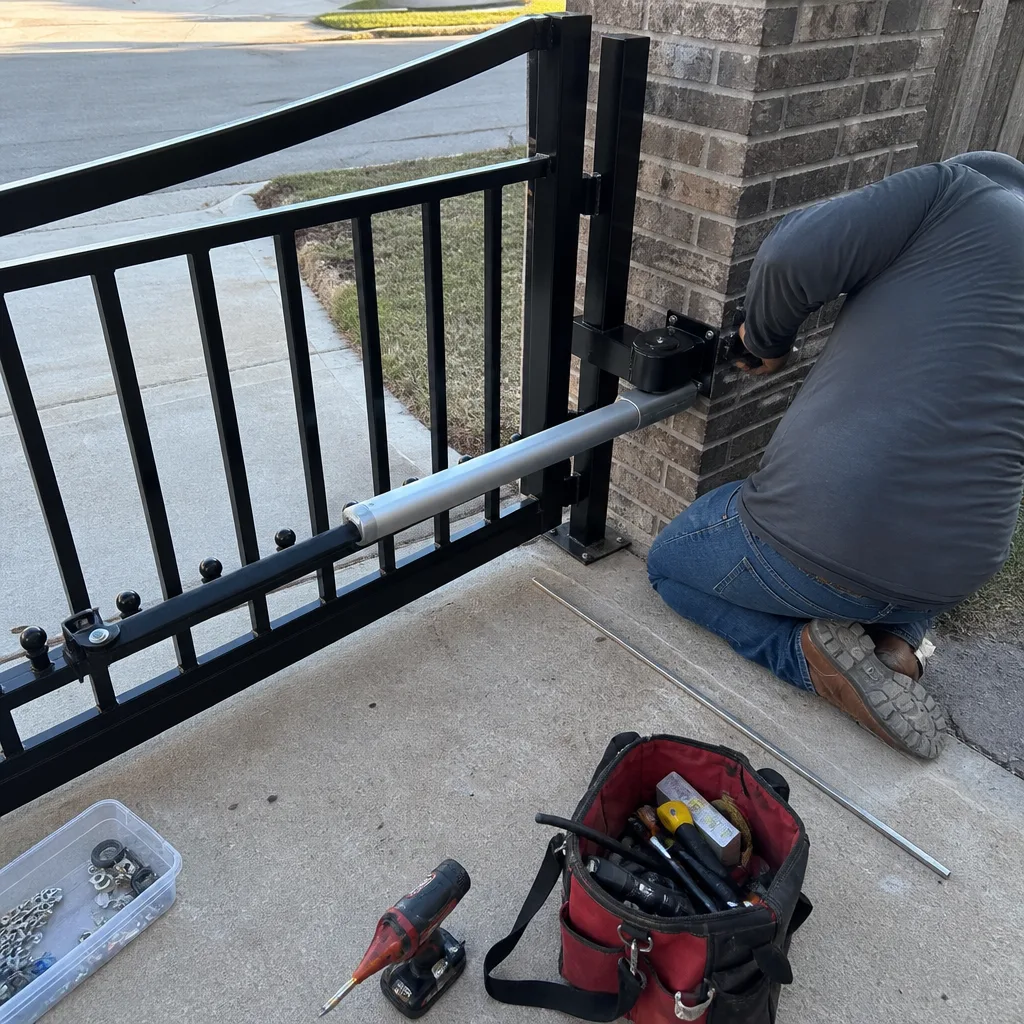 After
After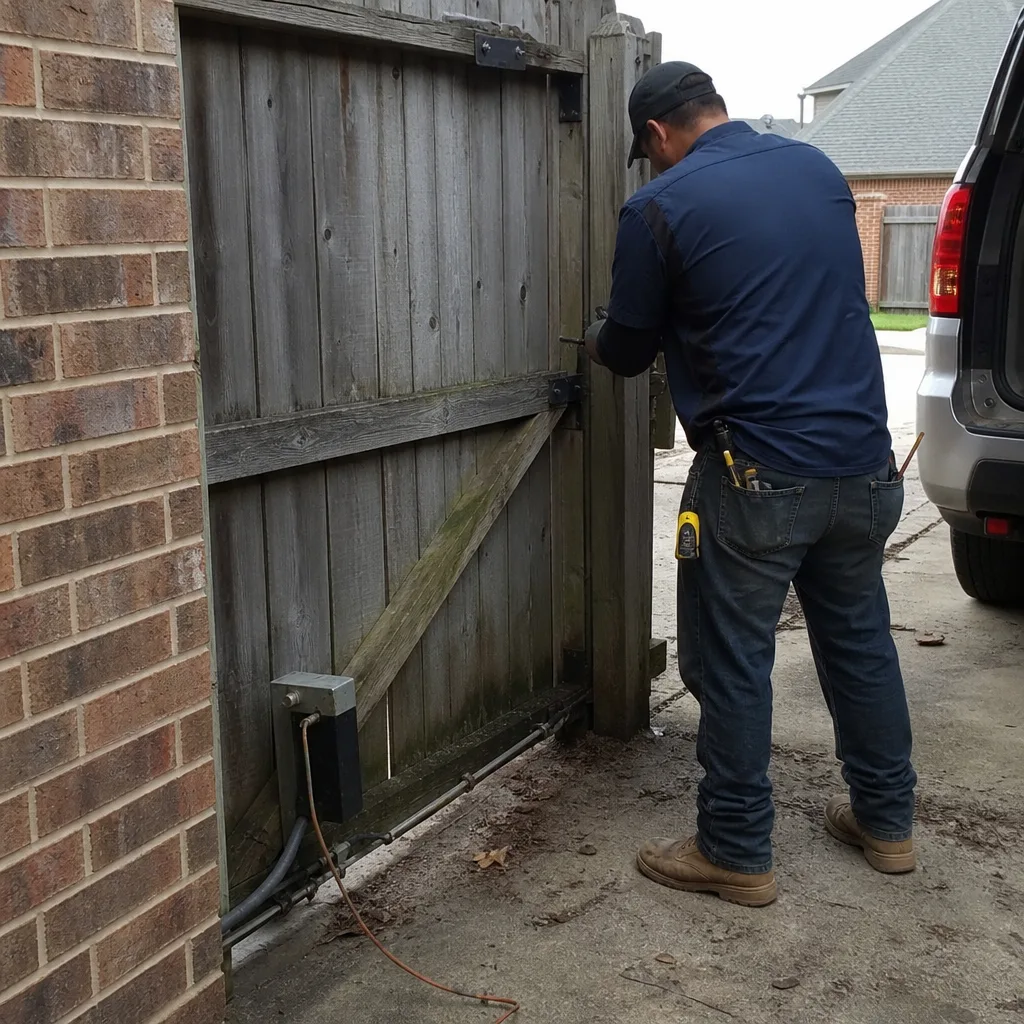 Before
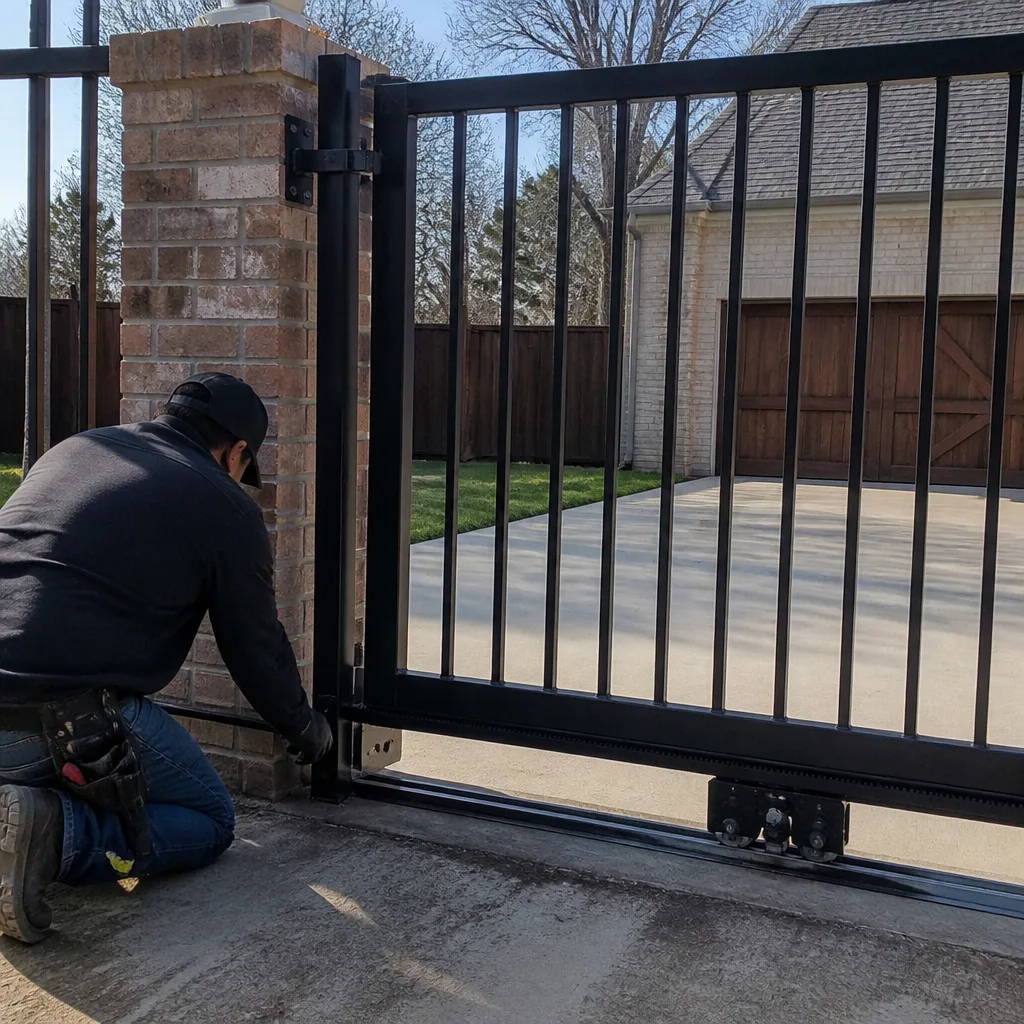 After
After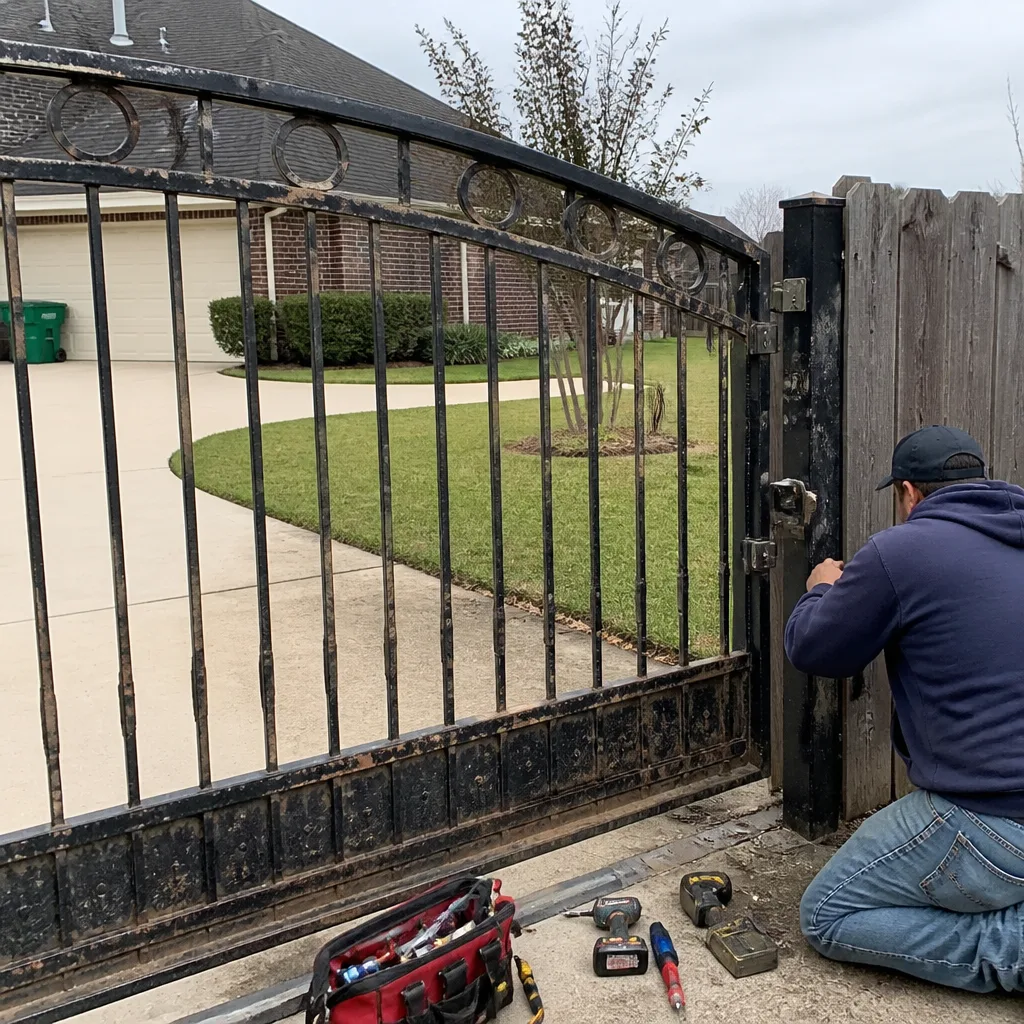 Before
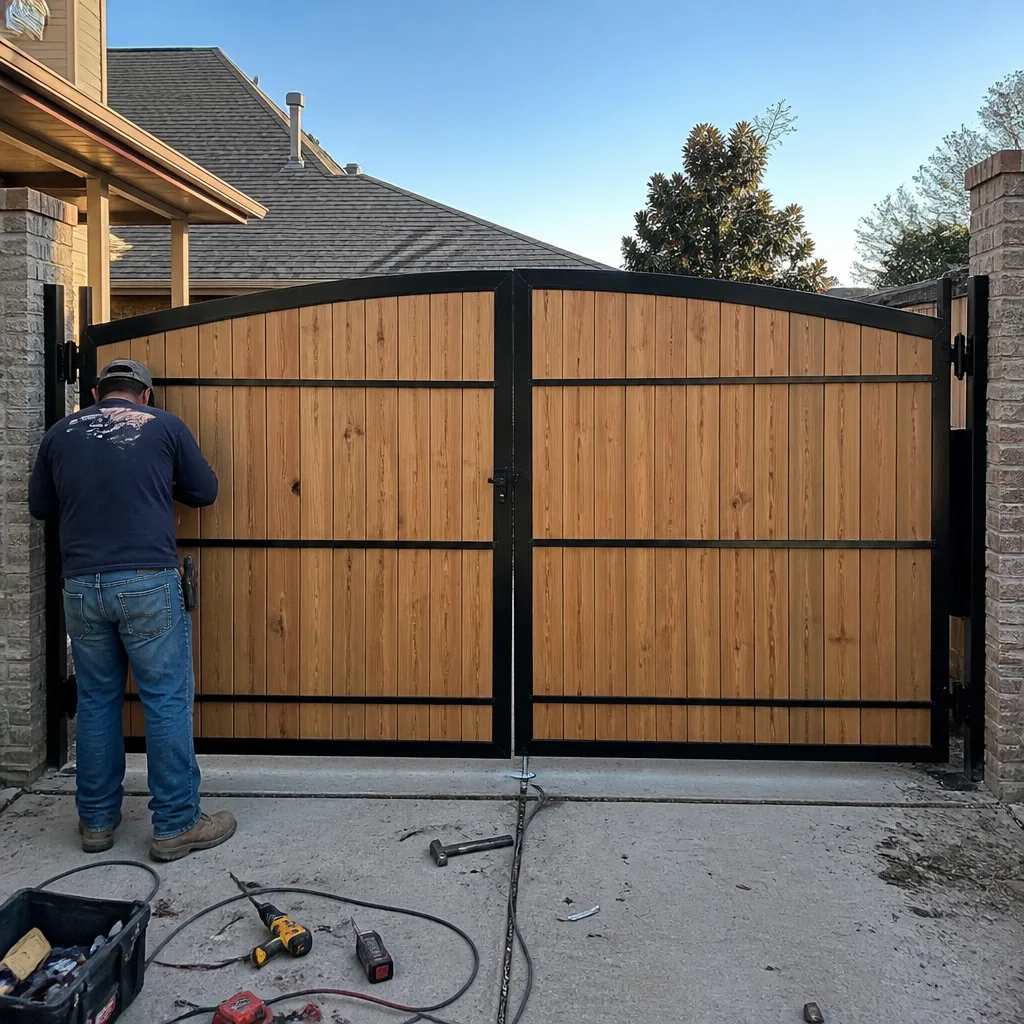 After
AfterHow to Hire a Gate Repair Contractor in Pearland: A Step-by-Step Guide
Asking a gate contractor for references is the least useful vetting question you can ask. Anyone can hand you three phone numbers that go to a cousin, a neighbor, or a past version of themselves. A far better question, one that actually separates a disciplined shop from a guy with a truck and a magnet, is this: what documentation do you leave behind when the job is done? Watch how they answer. If they pause, you’ve just learned everything you need to know. This guide walks through the hiring conversation as a diagnostic tool, and it’s written with Pearland specifically in mind, because what we see on gates in Shadow Creek Ranch is different from what we see in Silverlake, and what we find on a five-year-old FAAC operator near Pearland Parkway is different from what we find on a twenty-year-old Viking swing arm off Broadway. For a deeper look at local maintenance, see our Seasonal Gate Repair Care for Pearland: Year-Round Homeowner’s Guide. By the end, you’ll know the five questions that matter, why a verbal estimate is a structural problem rather than a preference, what a real documentation package looks like, and how to compare two written quotes when the line items refuse to line up.
Quick Answer
To hire a gate repair contractor in Pearland, require a written scope and a written price before any work begins, ask what documentation they’ll leave behind, and confirm they service your existing automation brand rather than steering you toward a replacement you may not need. A contractor who diagnoses before quoting, prices in writing, and photographs what they found and fixed is the one worth your driveway.
Table of Contents
- The Five Questions to Ask Before Scheduling Any Estimate
- Why a Verbal Estimate Is a Structural Problem
- What a Post-Repair Documentation Package Should Contain
- Red Flags That Appear During the Estimate Call Itself
- How to Compare Two Written Quotes When the Line Items Don’t Match
- What Pearland’s Climate and Codes Mean for Your Gate
- Common Mistakes to Avoid
- When to Call a Professional
- Frequently Asked Questions
BeforeAfterThe Five Questions to Ask Before Scheduling Any Estimate
Most homeowners call a gate company and lead with “how much do you charge?” That’s the wrong first question, because the answer depends entirely on what’s actually wrong, and no honest contractor should be quoting a price before they’ve seen the gate. The right first questions are about process, not price. Here are the five we recommend asking, in order, and what each answer reveals.
1. “Do you write the price down before you start work?”
This is the single best filter in the industry. A contractor who says “we’ll see once we get into it” is telling you they reserve the right to discover the problem on your dime, after the meter is already running. A contractor who says “yes, we hand you a written price before we touch anything” is telling you they’ve done enough diagnostic work to know what they’re dealing with. In Pearland, where a swing-gate motor replacement on a FAAC 400 or a BFT Deimos can run anywhere from $1,100 to $2,800 depending on whether the arm bracket is intact and whether the control board survived, that written number is the difference between a planned expense and an open-ended invoice.
2. “What brands do you service?”
Listen for the pause. A company that services nine major gate-automation brands will answer immediately, because the names are on their truck and in their service software. A company that says “all of them” and then pivots to “well, honestly, that motor’s getting old, you might want to think about replacing it” is telling you they only know one or two brands and would rather sell you a new unit than diagnose the one on your property. Ask specifically about your motor. If it’s a Viking or a Linear or a DoorKing and the answer feels vague, that’s a red flag. We service LiftMaster, FAAC, BFT, Linear, Viking, DoorKing, Elite, Ghost Controls, and Mighty Mule. That matters in Pearland because the subdivisions here are a patchwork. A home in Southern Trails might have a builder-grade Mighty Mule, while a custom property in Green Tee might have a Viking swing arm on a welded steel gate. One contractor should be able to handle both without blinking.
3. “What do you leave behind when the job is done?”
The answer you want includes the word “photo” or “documentation.” The answer you don’t want is “a clean gate” and a smile. A real documentation package is the difference between a repair you can build on and a repair you’ll have to re-discover the next time something fails. More on this in a moment, because it’s important enough to deserve its own section.
4. “Who am I going to see at my door?”
You deserve a name and a face before the technician arrives. Some companies dispatch whoever is available and you find out who that is when the van pulls up. Others send a background-checked, uniformed technician whose name and photo you receive in advance. In Pearland, where many homeowners leave for work in Houston before a morning appointment and rely on a spouse or a neighbor to meet the tech, knowing who’s coming isn’t a nicety. It’s a security question.
5. “What happens if the same problem comes back in three months?”
This is the question that separates guarantees from shrugs. Listen for a specific answer with a specific window. “We’ll make it right” without a timeframe is not an answer. A one-year promise on every repair, stated plainly, no expiration and no fee within that window, is the kind of answer that tells you the contractor actually believes in their work. In our business, we call it a 365-Day Done Right Promise. If the repair isn’t right, we make it right. No argument, no invoice.
- Ask if the price is written down before work starts.
- Ask which automation brands they service, and name yours specifically.
- Ask what documentation they leave behind when the job is done.
- Ask who will be at your door, and whether you’ll know in advance.
- Ask what happens if the same problem recurs within a year.
Gate repair in Pearland doesn’t have to be a gamble, and these five questions take about three minutes on the phone. That’s a small investment for the amount of information they return.
Why a Verbal Estimate Is a Structural Problem
A verbal estimate isn’t just a preference some homeowners have for a more formal process. It’s a structural problem, because it means the contractor hasn’t done the thinking yet. When someone says “ballpark, you’re probably looking at $400 to $600, but I’ll know more once I open it up,” they’ve just told you two things. First, that the diagnostic phase will be billed as a discovery process rather than a diagnostic one. Second, that the final number is subject to change in only one direction.
The alternative is a written scope. A written scope forces the contractor to actually diagnose the problem before quoting it, because once the scope is on paper, it’s a commitment. If the scope says “replace right-side limit switch on Linear actuator, re-set travel limits, photograph new positions” and the actual work turns out to be more involved, that’s a conversation. But it’s a conversation that starts from a documented diagnosis, not from a guess. There’s a meaningful difference between “the limit switch was set 12 degrees past travel; we reset it and photographed the new position” and “yeah, we adjusted something in there, should be fine now.” One of those sentences can be verified. The other can’t.
Requiring a written scope also doesn’t make you difficult. It makes you a customer who expects the contractor to know their trade. Frame it plainly: “Before you start, I’d like the scope and the price on paper.” A contractor who does this as standard practice will say “of course.” A contractor who doesn’t will hesitate, and that hesitation is information.
The way we work under our Haven Standard is built around Clause 1: have it in writing. The flat price is written and handed over before any work starts, every single job. Not just the big installations. Every repair, every motor swap, every photo-eye realignment. That habit came out of Adrian Vance’s commercial access-control background starting in 2014, where a documented scope wasn’t a courtesy. It was a contract requirement. We brought it to residential gates in Pearland because a homeowner deserves the same protection a commercial property manager gets.
One more point worth making: a written scope protects the contractor too. When the scope lists exactly what was found, what was done, and what part is now in place, there’s no disagreement later about what the job included. That’s why Vance Gate Repair’s Pearland home base treats documentation as a core part of the service rather than an add-on. It’s not paperwork for the sake of paperwork. It’s the record that makes the guarantee enforceable.
What a Post-Repair Documentation Package Should Contain
After the gate is fixed and the technician is packing up, you should be holding something more than an invoice. Here’s what a real documentation package contains, and why each piece matters.
- Photos of the problem before it was fixed. A misaligned photo-eye doesn’t look like much to the untrained eye, but the photo shows the gap. A cracked hinge bracket shows the stress point. These photos are how you know the diagnosis was real, not invented.
- Photos of the completed work. The new bracket, welded and painted. The new limit switch, mounted and adjusted. The motor arm reattached. Evidence that the work described on the invoice actually happened.
- A written record of limit-switch readings. On any motor that opens and closes, limit switches tell the machine where to stop. A technician who records the before and after values is telling you they calibrated the gate, not just replaced a part and hoped. “Opened 97 degrees, now 90” is data. “Seems better” is not.
- A parts list with model numbers. Not just “new motor,” but “FAAC 400 operator, model XYZ, serial number noted.” This matters in three years when a different technician shows up and needs to know what’s already on the gate. It also matters if you ever sell the house and want to show the buyer what’s been maintained.
- A wiring diagram or a written description of the configuration. On anything involving a control board, a photo-eye, a keypad, or an intercom, a simple diagram of what connects to what is the single most useful artifact a future service call can have. You may never look at it. The next technician will, and they’ll thank whoever left it.
If none of this sounds typical, that’s because it isn’t. Most gate companies in Pearland hand you a receipt with a line item that says “gate repair.” What you don’t get is what we leave under our Haven Standard Clause 4: evidence on every job. Every visit includes a photographed record of what was found, what was adjusted, and what was installed, left with the homeowner and filed in the job record. The same wiring-diagram habit Adrian Vance developed on commercial access-control sites now applies to a driveway gate off Pearland Parkway. It doesn’t cost you anything extra. It just means the next repair starts from a documented history instead of a blank page.
Red Flags That Appear During the Estimate Call Itself
Most advice about vetting contractors focuses on what happens after the work is done. But by then you’ve already made the hire. The estimate call itself is where most of the useful signal lives, if you know what you’re listening for. Here are the red flags to watch for before a technician ever arrives.
- Pricing by the hour without a ceiling. “We’re $95 an hour plus parts” sounds precise. It isn’t. It’s an open-ended meter with no upper bound, and it rewards slow work. Ask what the total will be. If they can’t answer, they haven’t diagnosed anything.
- “I’ll need to see it first” as an answer to a simple question. Note the difference between this and a legitimate “I need to diagnose before I quote.” If you’ve described a gate that won’t close and asked whether it’s likely a limit switch or a motor, a contractor who says “could be anything” without asking follow-up questions is revealing that they don’t actually know how to diagnose over the phone. A skilled tech asks whether it opens but doesn’t close, whether it reverses mid-travel, whether the remote works but the keypad doesn’t. The questions themselves are diagnostic.
- Steering you toward replacement before they’ve seen the gate. If the first response to “my gate motor is acting up” is “those motors are getting old, you’d be better off replacing the whole thing,” be suspicious. This is a sales script, not a diagnosis. It’s especially common with one-brand specialists who don’t service nine brands and therefore prefer to replace whatever they can’t repair. A BFT control board with a bad relay is repairable. A FAAC arm with a stripped gear is repairable. Replacement is sometimes the right call, but it should be a conclusion based on evidence, not a default based on inventory.
- Vague guarantee language. “We stand behind our work” means nothing. “All our repairs are covered for a full year, no fee, no argument” means something specific. Ask them to name the window.
- No answer when you ask about the technician. You asked who’s coming to your home. They said “one of our guys.” In Pearland, where a gate repair means giving a stranger access to your property and possibly your home security system, that answer isn’t adequate. You should be able to know a name before you open the door.
None of these are definitive proof of bad work on their own. But they’re patterns, and patterns are how you make a decision with limited information. A contractor who gives you a clear answer to all five questions in this guide is likely to run a clear operation. A contractor who fumbles all five is likely to leave you with a receipt that says “gate fixed” and a problem that returns in six weeks.
How to Compare Two Written Quotes When the Line Items Don’t Match
So you did the work. You got two written quotes from two Pearland gate companies, and now you’re looking at two pieces of paper that appear to describe different jobs. One says “replace swing gate motor, $1,850.” The other says “replace actuator arm and control board, re-set limits, test photo-eyes, $2,300.” Which one is better?
The answer isn’t the price. It’s the diagnosis. The first quote tells you almost nothing about what’s actually wrong, which means the contractor either hasn’t diagnosed it or doesn’t want you to know what they’re replacing. The second quote is a scope. It tells you the actuator arm failed, the control board needs replacing, and the limit switches will be re-calibrated after installation. The $450 difference might actually be the cheaper quote for the job that actually fixes the gate, because a vague quote at three hundred dollars less might mean a partial repair that leaves the underlying problem in place.
Here’s how to compare two written quotes when the line items don’t match.
- Look for the diagnosis first, the price second. A quote should tell you what’s wrong and what will be done about it. If one quote names the failed component and the other just names the gate, the named one is more trustworthy.
- Check for evidence of calibration, not just parts. Replacing a motor without re-setting limit switches and testing the photo-eye alignment is half a job. Look for “limit switch adjustment,” “travel reset,” “photo-eye alignment,” “cycle test.” These are the line items that tell you the technician intends to leave the gate working properly, not just leave new parts in place.
- Compare warranty language, not just price. Does one quote include a one-year guarantee in writing and the other is silent on it? That’s a line item too, even if it doesn’t have a dollar figure.
- Note what’s missing. A quote that doesn’t mention the photo-eye at all may mean the technician didn’t check it. A quote that doesn’t mention the limit switches may mean they’re not planning to adjust them. The absence of a line item can be as informative as its presence.
- Don’t reward the cheapest quote that took the least effort. A contractor who spent thirty minutes diagnosing and wrote a detailed scope has already done more work than the one who spent four minutes and wrote a one-line number. The quote is a sample of how the job will be run.
If you’ve got a written estimate from another Pearland company and want a second set of eyes on it, our gate installation and repair team will review it at no cost. Bring the paperwork and we’ll tell you what’s covered, what’s missing, and what we’d quote for the same scope. That’s a standing offer, no obligation attached.
One more practical note for Pearland homeowners: when you’re comparing quotes on a motor replacement, ask both companies whether the quote includes reusing the existing mounting bracket or fabricating a new one. This is a real line-item difference. Reusing the bracket saves money and is often perfectly sound. Fabricating a new one adds cost and is sometimes necessary. If one quote includes bracket fabrication and the other doesn’t mention the bracket at all, you’re not looking at the same job. Ask both to confirm. The same applies to whether the quote includes a battery backup. Many Pearland homes lose gate function during storm season, and a battery backup is a small add-on that one quote may include and the other may not. These are the details that make two quotes non-comparable until you’ve made them comparable.
What Pearland’s Climate and Codes Mean for Your Gate
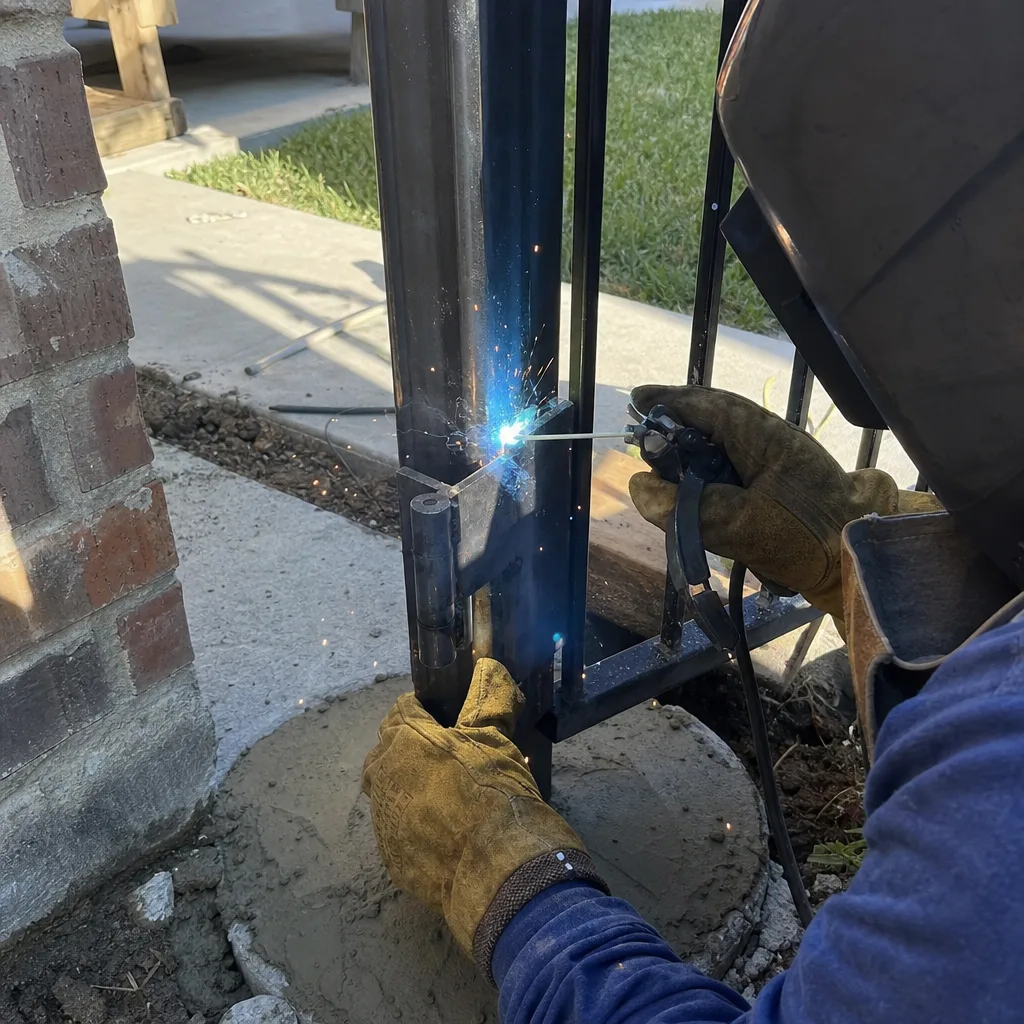
Pearland sits in a humid subtropical zone with heavy clay soil, regular storm fronts off the Gulf, and the occasional freeze that sends unprepared gates into failure. This isn’t generic Texas gate advice. It’s specific to what we see across the city’s subdivisions, and it matters when you’re hiring.
The clay soil is the big one. Pearland’s expansive clay shifts with moisture, which means gate posts settle over time. A gate that was plumb in 2019 may be sagging by 2025, not because the hinges failed but because the soil moved. A contractor who works in Pearland knows to check post plumb before assuming the gate itself is the problem. A contractor driving in from another metro won’t think to look. In places like Shadow Creek Ranch and Silverlake, we regularly see gates that won’t close in summer because the clay has dried and shifted, pulling the latch out of alignment by a quarter inch. That’s a Pearland problem, and it requires a Pearland diagnosis.
The humidity also does a number on non-sealed electronics. Control boards in unsealed enclosures corrode. Limit switches rust. Photo-eye housings collect moisture. A gate motor that survived five years in Dallas might fail in three here, not because it was a worse motor but because the environment is harsher. When you’re hiring, ask the contractor whether they’re checking for moisture ingress in the control housing. If they don’t know what that means, keep looking.
On the code side, Pearland residential gates generally follow standard Texas safety requirements: photo-eyes on automatic gates, reversing edges or entrapment protection, and proper mounting height for controls. A gate motor and opener contractor in Pearland should be familiar with these requirements and should test the safety features as part of any repair, not treat them as optional. High-voltage work on a gate motor, particularly anything involving the power run from the house to the operator, is genuinely dangerous and belongs with a licensed professional. We never advise a homeowner to attempt that kind of work themselves.
Common Mistakes to Avoid
- Hiring the first company that answers the phone. Availability isn’t competence. A company that can be there this afternoon is great, but ask the five questions anyway. A live person answering around the clock is a sign of readiness, not a substitute for a written scope.
- Accepting a verbal estimate without pushing back. “About four or five hundred, maybe more once we get in there” is a range, not a quote. Ask for a written scope and price. If the contractor balks, that’s your answer.
- Assuming the cheapest quote is the best value. A quote that doesn’t mention calibration, safety testing, or documentation is cheaper because it includes less. Often a lot less.
- Letting a contractor talk you into a full replacement without a documented diagnosis. Replacing a FAAC arm with a stripped gear is repair. Replacing the entire FAAC system because the arm failed is a sales opportunity. Ask for the evidence.
- Not asking about post-repair documentation. If the invoice says “gate repair” and nothing else, you now own a gate you can’t prove was repaired. The next company will start from zero, and you’ll pay to re-diagnose what should have been on record.
- Ignoring the specific automation brand on your gate. In Pearland, homes have everything from builder-grade Mighty Mule openers in newer subdivisions to Viking and Linear systems on custom properties. A contractor who doesn’t know the difference will cost you time and possibly a functional motor that just needed the right technician.
- Skipping the question about who shows up at the door. You’re letting a stranger onto your property, often while you’re not home. If the company can’t tell you the technician’s name before arrival, that’s a process gap, not an inconvenience.
When to Call a Professional

Some gate problems are worth investigating yourself: a dead remote battery, a tripped breaker you can visibly identify, a hinge that’s obviously loose and needs tightening. But anything involving the gate motor, the control board, or the travel limits of an automatic gate belongs with someone who does this every day. A gate that reverses mid-travel, fails to close fully, or makes a grinding noise when opening is not a DIY project. The springs and cables on a gate under tension carry enough stored energy to cause serious injury if mishandled, and the electronics on a 24-volt system are easy to damage with a wrong wire placement.
If your Pearland gate is misbehaving, call a professional who will diagnose it before quoting it, write the price down before starting, and hand you a documented record when the job is done. Vance Gate Repair Pearland offers free estimates in Pearland. For The Complete Guide to Gate Repair in Pearland and more, visit our site, or call (346) 253-3225 and a live person answers, day or night.
Frequently Asked Questions
Most gate repairs in Pearland run between $180 and $450 for common fixes like photo-eye realignment, limit switch adjustment, or hinge replacement. Motor replacements start around $1,100 and can reach $2,800 or more depending on the brand, whether the arm bracket is intact, and whether the control board also needs replacement. An exact written quote requires a diagnosis first. Call (346) 253-3225 for a free estimate.
Yes, many Pearland gate repair companies, including ours, offer same-day service for urgent repairs, especially when a gate won’t close and leaves the property unsecured. A live person answers our phones 24/7 at (346) 253-3225.
A gate repair estimate should include a written description of the problem, the specific parts being replaced with model numbers where applicable, any calibration or adjustment work, a written flat price, and the warranty period. A one-line estimate that just names the gate is not an estimate. It’s a placeholder. Ask for the scope.
A competent contractor can usually tell you after a diagnostic visit. The evidence matters: a burned-out capacitor on a BFT board is a repair. A seized gearbox with housing damage may warrant a replacement. In Pearland, we often find that a motor a homeowner was told to replace simply needed a limit switch reset or a new arm bracket. Insist on a documented diagnosis before agreeing to replace anything.
No. Some companies specialize in one or two brands and will steer you toward replacing anything else. We service nine major automation brands including FAAC, BFT, Linear, Viking, DoorKing, LiftMaster, Ghost Controls, Elite, and Mighty Mule. Always ask specifically about the brand on your gate before booking.
At minimum, a real documentation package includes photos of the problem before repair, photos of the completed work, written limit-switch readings, a parts list with model numbers, and a wiring diagram or configuration description. If your contractor hands you a receipt that says “gate repair” and nothing else, ask for the record. You paid for it. Call (346) 253-3225 and we’ll show you what a proper documentation package looks like.
The Bottom Line
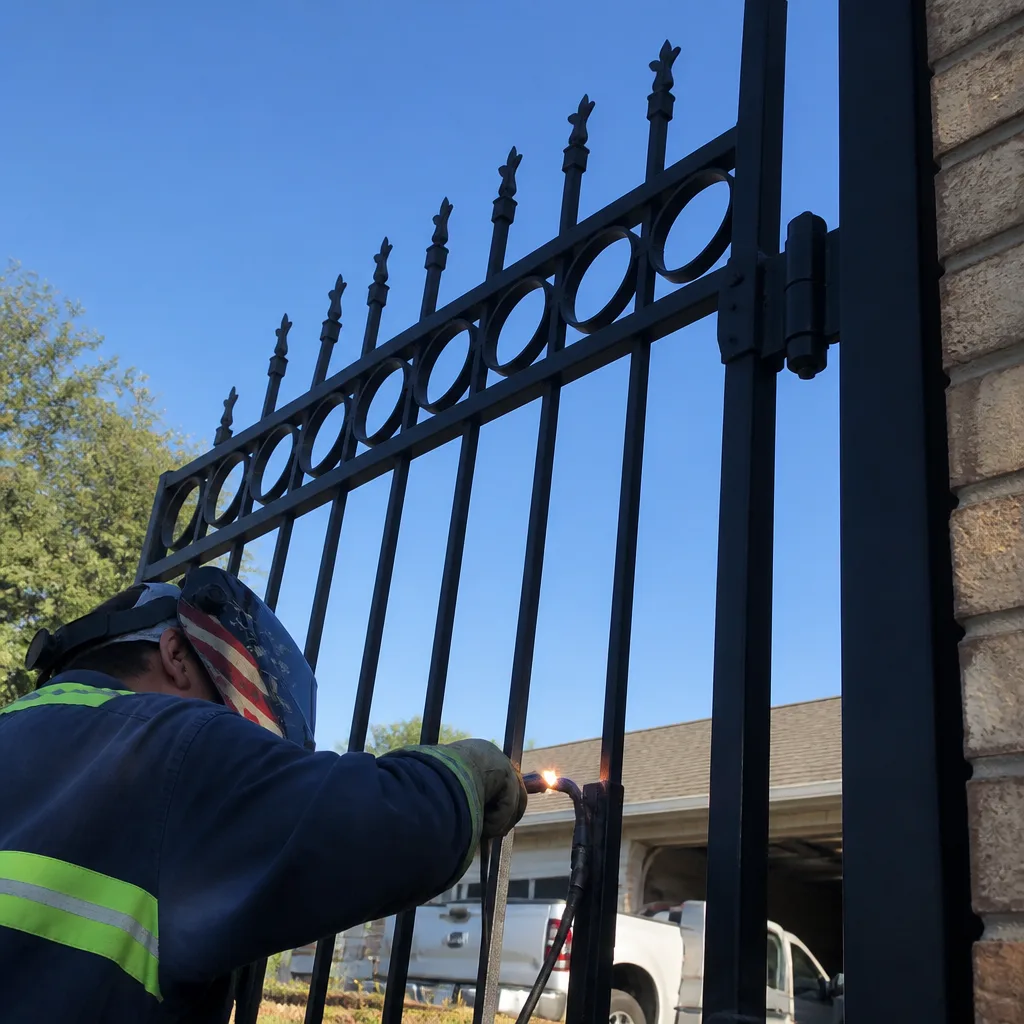
Hiring a gate repair contractor in Pearland comes down to one habit that predicts almost everything else: whether they write it down before they touch it. A written scope forces a real diagnosis. A written price eliminates the surprise invoice. A documentation package means the next repair starts from a record instead of a guess. Ask the five questions, compare quotes by diagnosis and scope rather than price alone, and pay attention to what’s missing from the line items. For more guides & resources, explore our blog. The gate on your Pearland driveway is a piece of security infrastructure, not just a convenience. Treat it that way, and hire accordingly.
Written by Adrian Vance, Owner at Vance Gate Repair Pearland, serving Pearland since 2014.