
Last updated September 20, 2026
Free on-site gate assessment - hinges, posts, and your LiftMaster or Nice gate operator checked before anything is quoted
The assessment is free and the quote is the invoice.

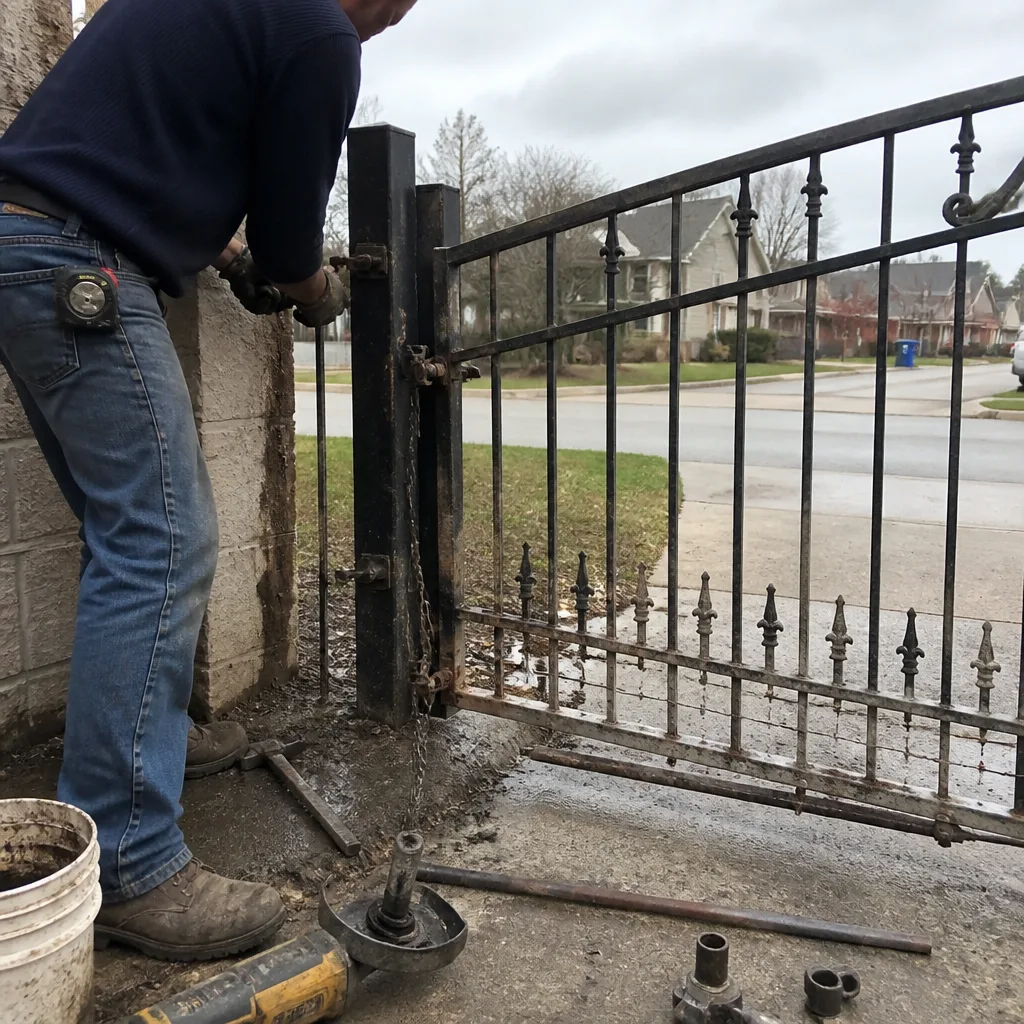 Before
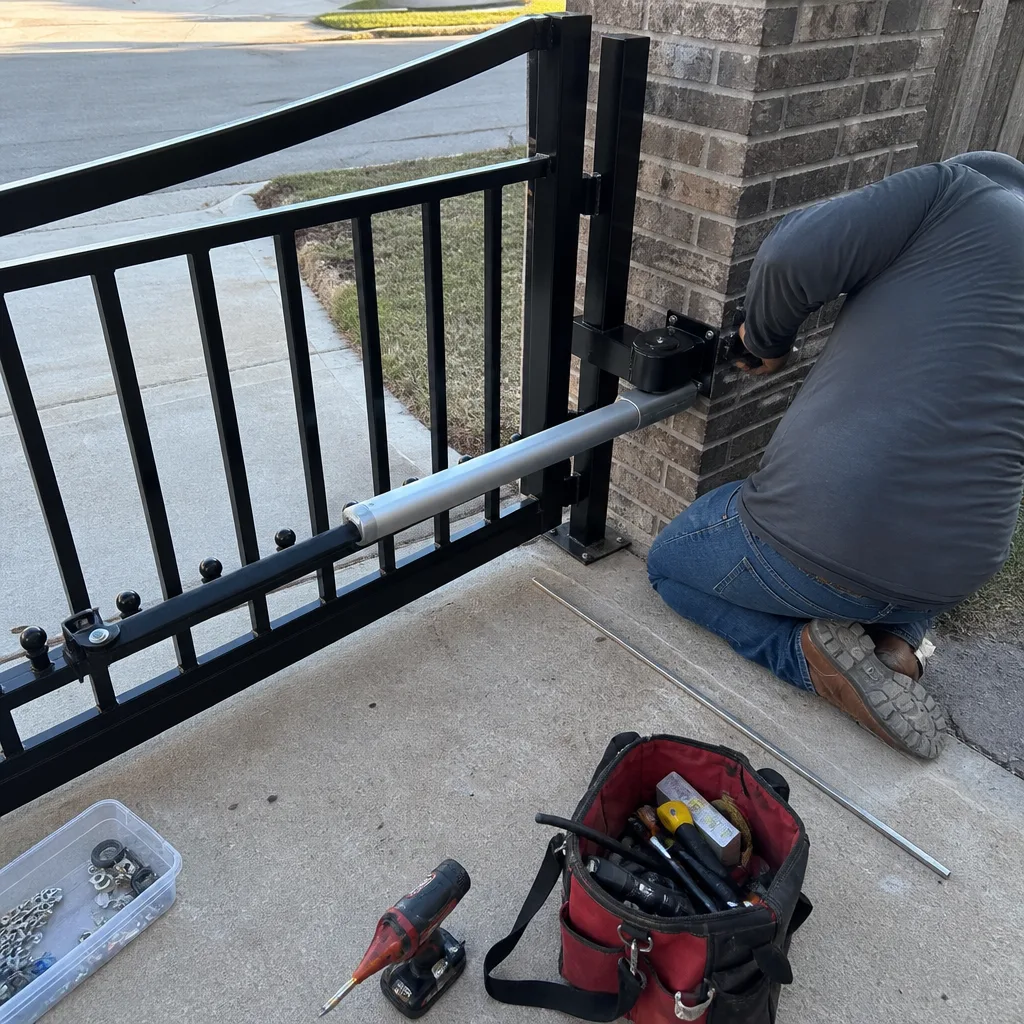 After
After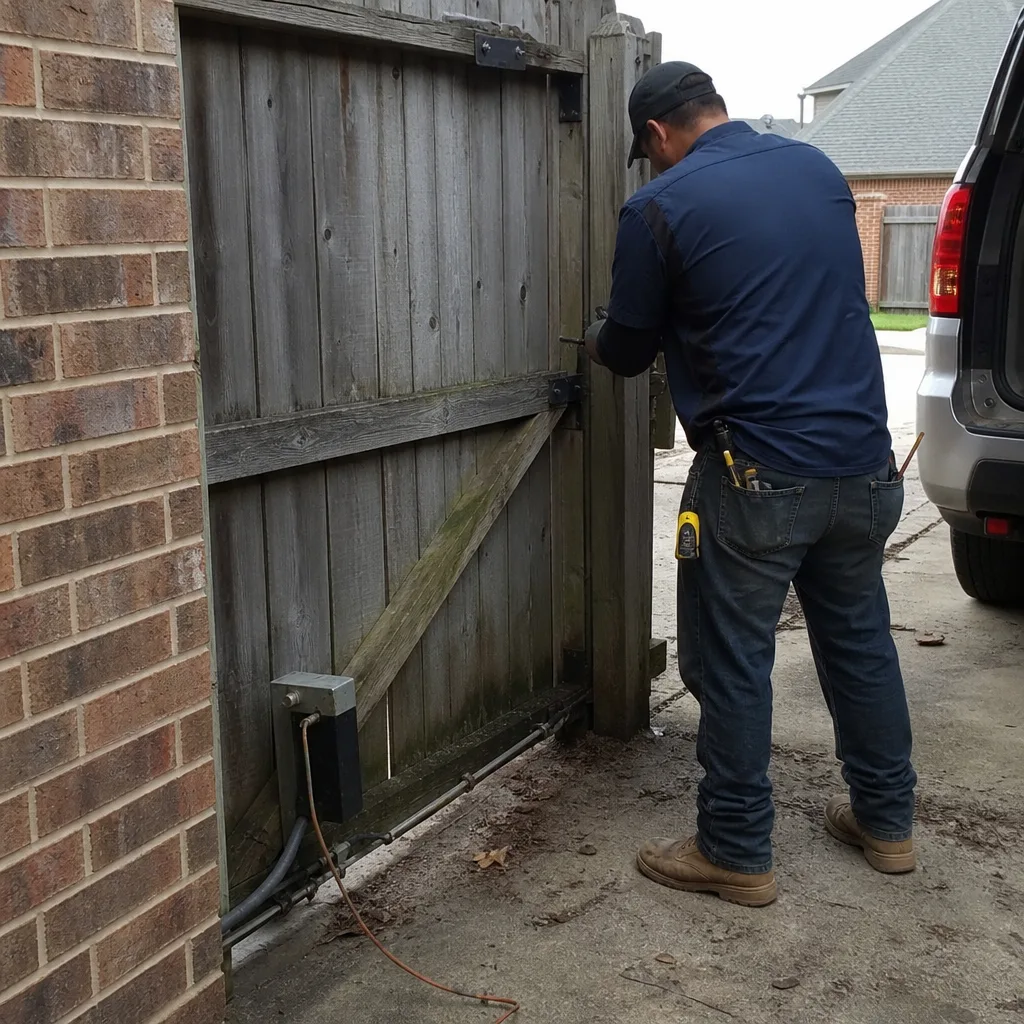 Before
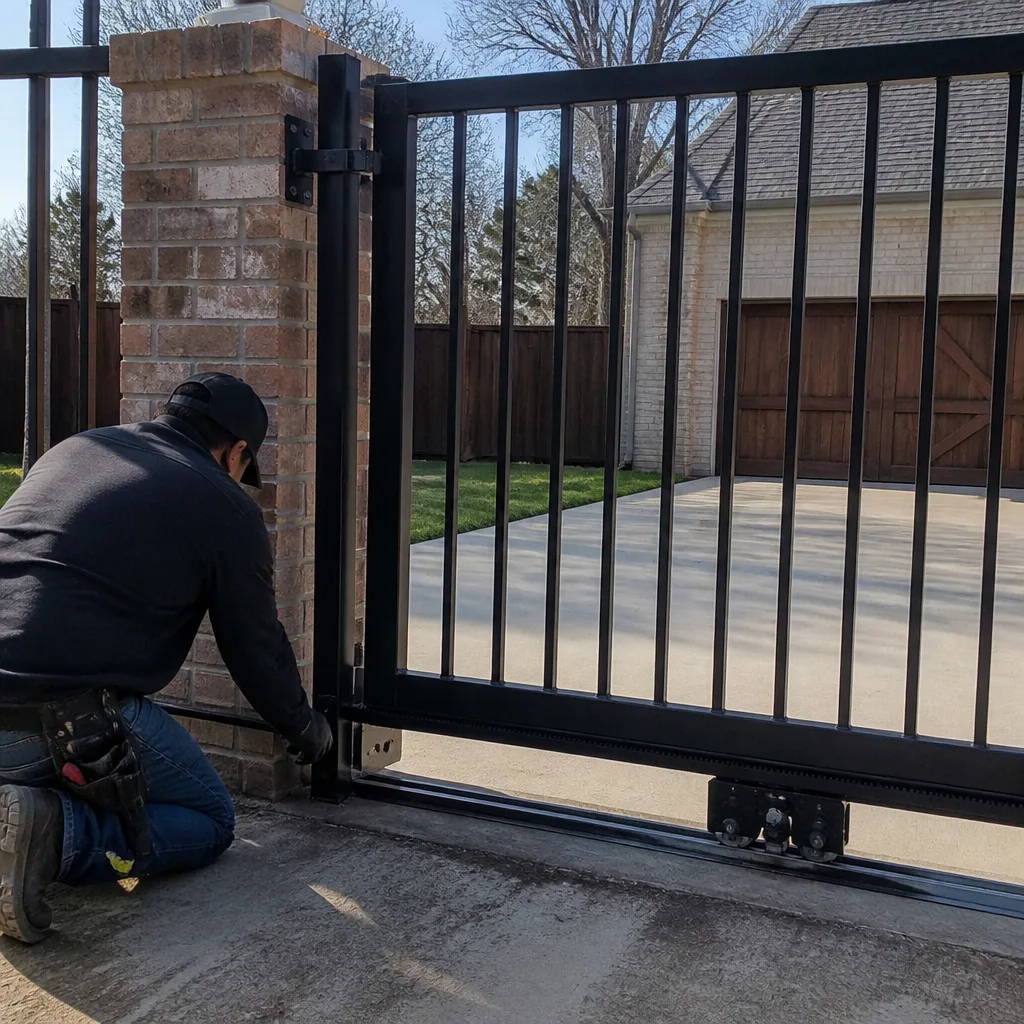 After
After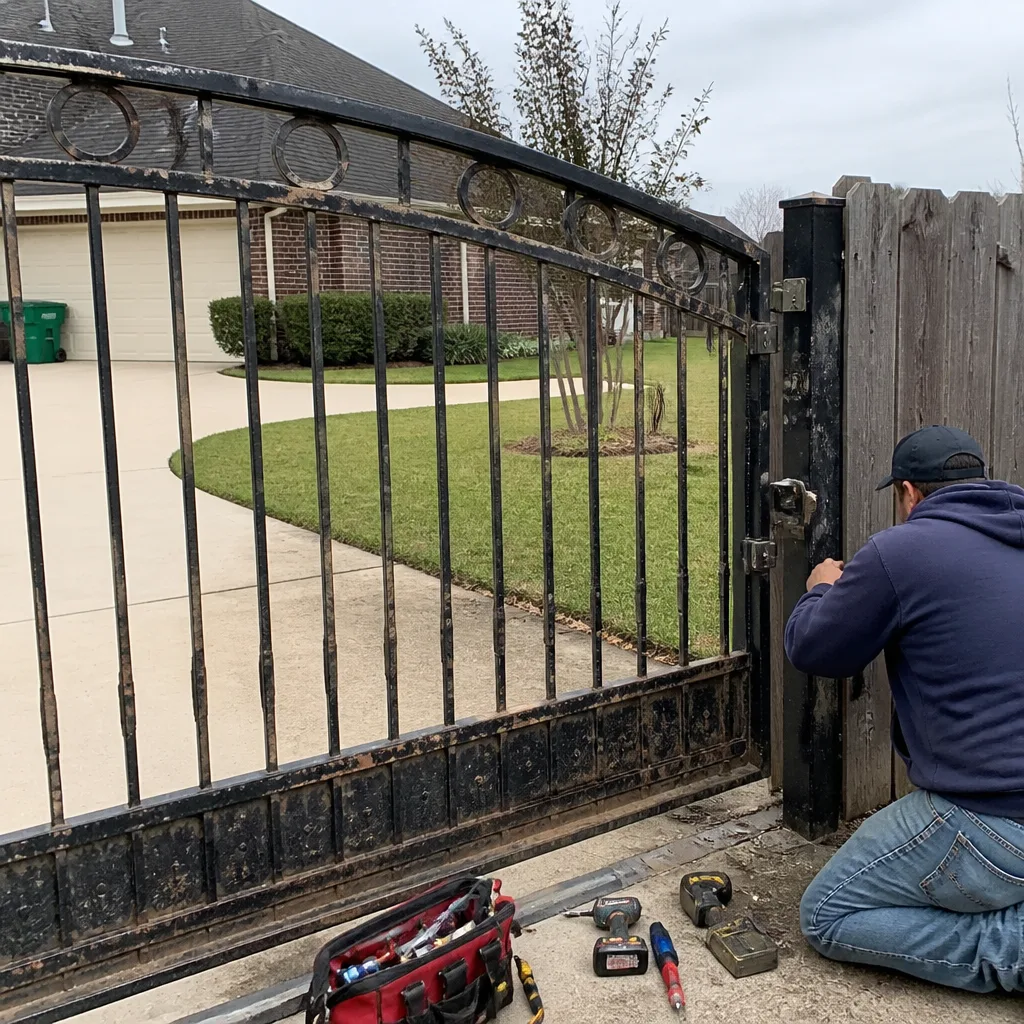 Before
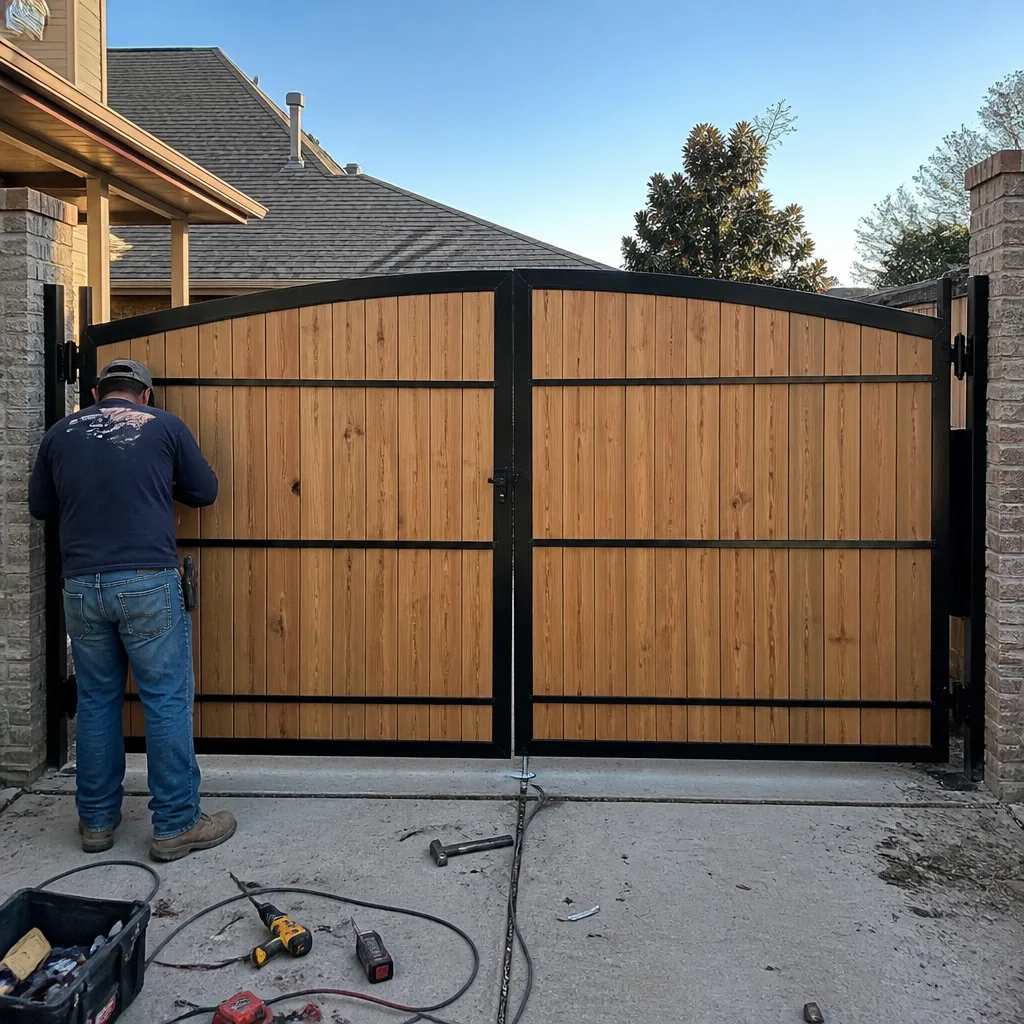 After
AfterGate Repair Warning Signs: A Pearland Homeowner’s Reference Guide
A gate that hesitates for two seconds before moving isn’t a minor annoyance. It’s a capacitor drawing down or a motor pulling too many amps against increased resistance, and both conditions escalate quickly. Most gate failures in Pearland don’t happen suddenly. They announce themselves weeks or months in advance through observable signals that get ignored because nobody mapped the symptom to the cause. This guide to hiring a gate repair contractor in Pearland pairs each visible sign to its likely failure mode and its urgency level, so you know whether you’re looking at a planned repair or an emergency. We’ve repaired gates across Pearland since 2014, and the patterns are consistent: the homeowner who catches the warning sign pays a fraction of the homeowner who waits for the failure.
Quick Answer
Gate repair warning signs in Pearland fall into five observable categories: grinding noise, hesitation before movement, unexpected reversal, slow operation, and partial opening. Each maps to specific causes, from failing capacitors and misaligned photo-eyes to rust-compromised hinges and swollen post concrete. Time-sensitive signs include grinding, reversal, and hesitation. Slow operation and partial opening typically allow a planned repair window of two to four weeks.
Table of Contents
- Symptom-to-Cause Table
- How to Tell Mechanical From Electrical Without Tools
- Urgency Ranking: Which Signs Can’t Wait
- Pearland-Specific Warning Signs
- What to Document When You Spot a Warning Sign
- What Waiting Costs: The Math of Deferred Gate Repair
- Common Mistakes to Avoid
- When to Call a Professional
- Frequently Asked Questions
- The Bottom Line
BeforeAfterSymptom-to-Cause Table
Every gate failure we’ve documented in Pearland follows a pattern. The symptom appears first, the underlying cause second, and the full failure third. Here’s the mapping we use on service calls, and it’s the same logic you can apply in your driveway.
The Five Primary Symptoms and Their Likely Causes
- Grinding noise during travel: Most often a worn drive gear in the operator, dry or failing ball bearings in the hinge line, or a chain that’s stretched past tension spec. On LiftMaster and FAAC operators, a grinding sound at startup usually indicates gear wear inside the gearbox. On the gate itself, grinding tends to come from the hinge side, not the motor.
- Hesitation before movement (1-3 second delay after the remote or keypad activates): A failing start capacitor on the motor, corroded contactor points inside the operator housing, or low voltage at the board caused by a degrading transformer. In Pearland’s humidity, we see condensation inside operator housings accelerate capacitor failure more than in drier climates.
- Unexpected reversal mid-travel: A misaligned photo-eye (the infrared beam that stops the gate if something crosses the path), a current-sensing board set too sensitively, or a physical obstruction dragging against the gate’s travel path. If the gate reverses at the same point every time, it’s a physical obstruction or a bent track. If it reverses randomly, it’s electrical.
- Slow operation compared to when the gate was new: A motor pulling high amps against increased mechanical resistance, low hydraulic fluid on BFT or Viking hydraulic operators, or swollen post concrete changing the gate’s hang geometry in Pearland’s clay soil. Slow operation is a cumulative signal. It means something is making the motor work harder, and that something doesn’t self-correct.
- Partial opening only: A limit switch that’s drifted out of position, a travel module on a Linear or LiftMaster board that’s lost its memory, or a physical stop that’s shifted. When the gate opens 70% and stops, the operator thinks that is full travel. The limit switch is the usual suspect.
None of these symptoms resolve on their own. Each one represents a component working outside its designed range, and every additional cycle adds wear that moves the repair from a parts-level fix to a replacement-level fix.
How to Tell Mechanical From Electrical Without Tools
You can separate mechanical warning signs from electrical ones using observation alone. The distinction matters because it determines whether you’re calling a welder or a board technician, and it changes what you document before the service visit.
The Observation Method
- Watch the gate’s first inch of movement. A mechanical problem shows itself immediately: the gate shudders, scrapes, or tilts as it leaves the closed position. An electrical problem usually shows a clean first movement followed by erratic behavior.
- Listen to the sound’s location. Mechanical noise comes from the hinge line or the travel path. Electrical noise comes from inside the operator housing: a hum, a click, a buzz that doesn’t match the gate’s motion.
- Test both directions. If the gate struggles opening but closes fine, suspect a mechanical bind on the open side or an internal operator issue. If the gate behaves identically in both directions, the problem is more likely electrical or control-board related.
- Disconnect the operator mentally. If you can push the gate manually (with the operator disengaged per the manufacturer’s release mechanism), does it move smoothly? A gate that’s stiff by hand has a mechanical problem. A gate that moves freely by hand but erratically under power has an electrical one. Note: never disconnect a high-tension spring or counterweight system without understanding the energy stored in it. Call a professional if you’re unsure.
This four-step observation takes under five minutes and gives the technician a head start. When we arrive at a Pearland home and the homeowner says “the noise is from the hinge side, and it only happens opening,” we know to load welding equipment and hinge stock before we pull into the driveway.
Urgency Ranking: Which Signs Can’t Wait
Not every warning sign demands same-day service. Some allow a planned repair window. Ranking them correctly is the difference between a $200 limit switch adjustment and a $900 operator replacement.
Tier One: Address Within 48 Hours
- Grinding noise during travel. Gear wear compounds. Every open-and-close cycle with a worn gear scores the mating surface deeper. Within three to five days of continuous grinding, the gear can strip entirely, and the gate becomes inoperable.
- Unexpected reversal at random points. This can be a safety-edge or photo-eye failure, and a gate that reverses unpredictably is a gate that can’t be trusted around children, pets, or vehicles. It’s also a sign the current-sensing circuit is receiving false triggers, which points to a board-level issue.
- Any spark, burning smell, or hot operator housing. This is an electrical fire risk. Disconnect power to the operator at the breaker and call a professional. We treat this as a life-safety call in Pearland, not a convenience repair.
Tier Two: Address Within Two Weeks
- Hesitation before movement. A failing capacitor or degrading transformer will eventually fail to start the motor at all. But you typically have a window. If the hesitation grows longer each day, compress your timeline.
- Partial opening only. The gate still functions, just incompletely. The limit switch or travel module is failing, and the gate will eventually stop at 50%, then 30%, then not at all.
Tier Three: Planned Repair Window of Two to Four Weeks
- Slow operation. This is a progressive condition. Document the travel time now, then re-time it in a week. If it’s getting slower, escalate. If it’s stable, schedule the repair at your convenience.
- Rust staining at post bases or hinge asymmetry. These are structural signals that develop over months. They don’t require emergency attention, but they do require a plan. Pearland’s wet season accelerates both.
If you’re unsure where your symptom falls, call Gate Repair in Pearland and describe what you’re seeing. We’ll tell you over the phone whether it’s urgent or schedulable, and the estimate is free either way.
Pearland-Specific Warning Signs
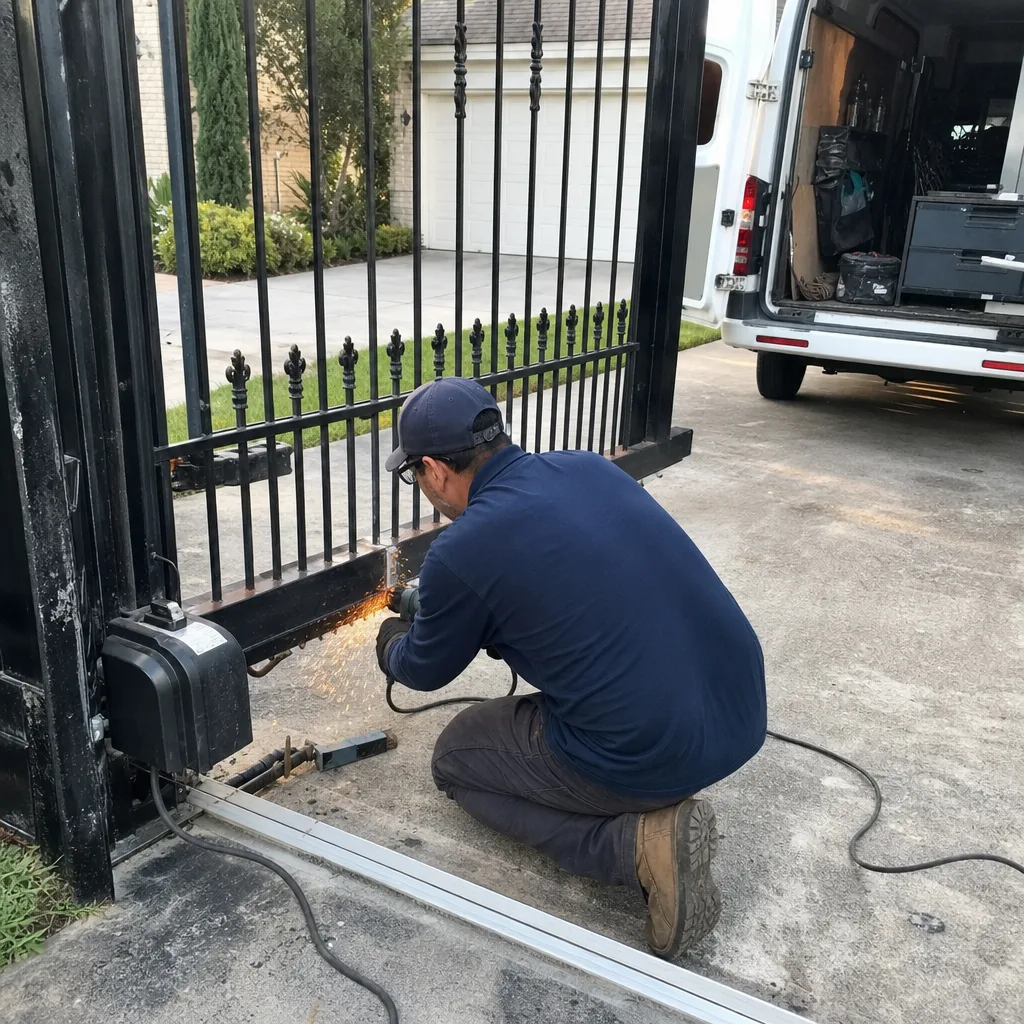
Pearland’s climate and soil create warning signs that don’t appear in drier parts of Texas. Homeowners here should watch for three conditions that map directly to local weather patterns, as covered in our seasonal gate repair care guide for Pearland.
Rust Staining at Post Bases
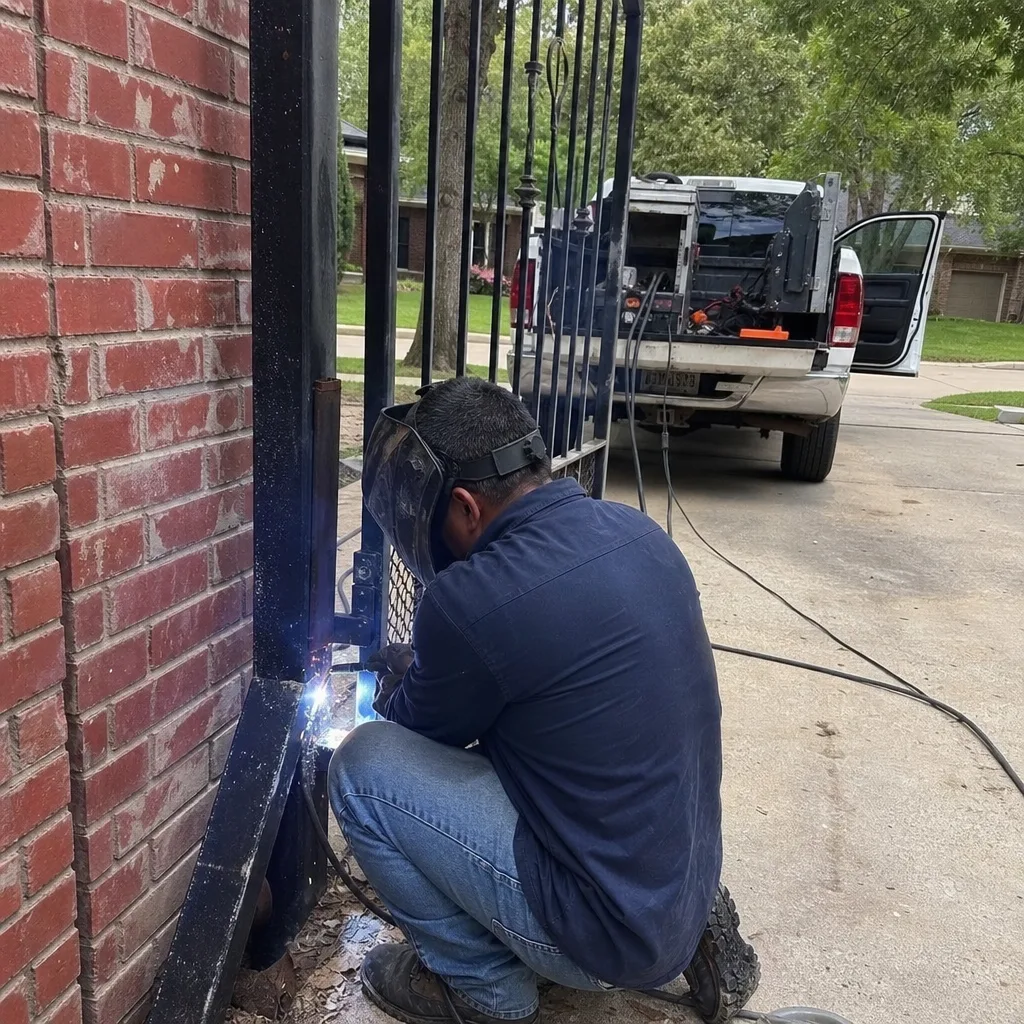
Pearland averages over 50 inches of rain annually, and the area’s clay-heavy soil holds moisture against steel post bases long after the surface dries. When you see rust-colored staining weeping from the base of a gate post, it’s not cosmetic. It means water has breached the post’s protective coating and the steel is oxidizing from the inside out. In neighborhoods like Silverlake and Shadow Creek Ranch, where gates are common on the larger lots, we regularly see post bases that look fine from the outside but have lost 30-40% of their wall thickness inside the concrete collar. The fix involves excavation, assessment, and often a welded sleeve or full post replacement before the gate sags enough to bind.
Hinge Gap Asymmetry After Wet Season
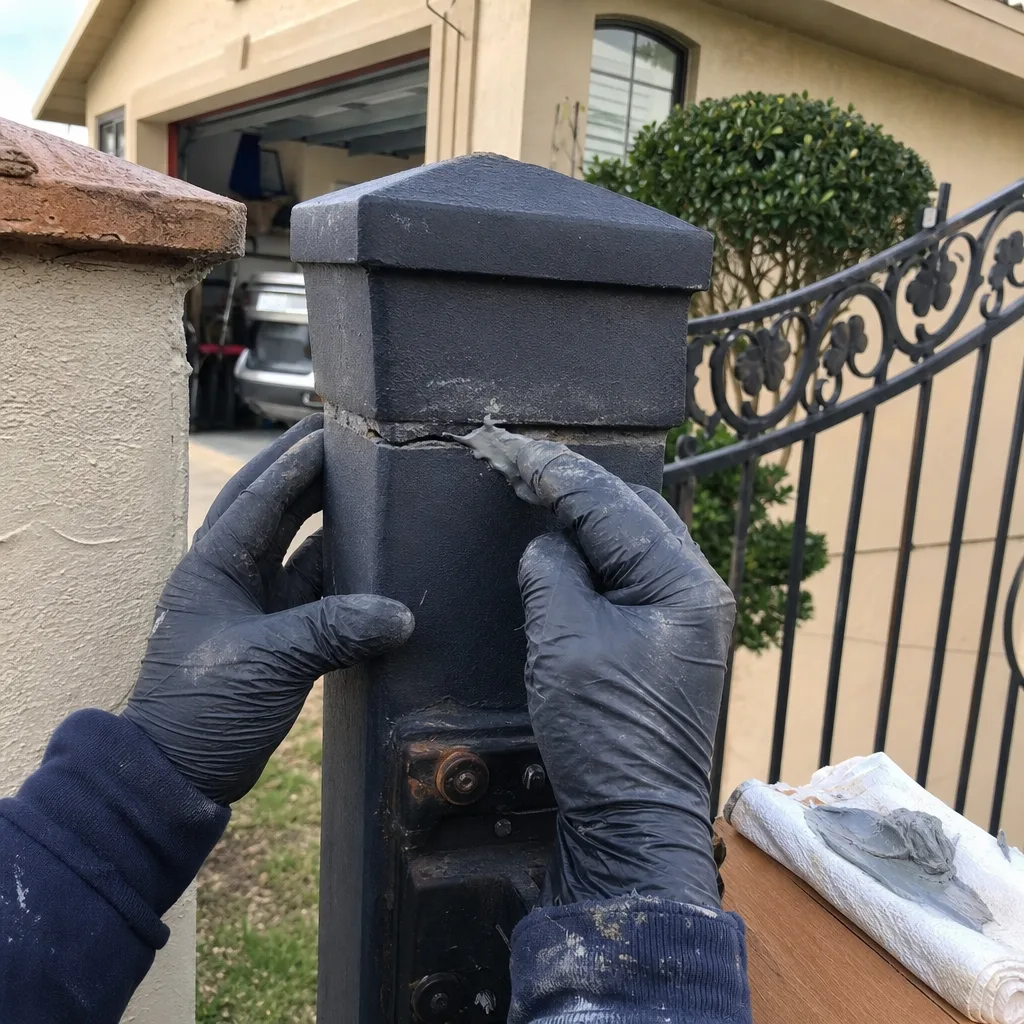
Pearland’s clay soil expands when wet and contracts when dry. This cycle, repeated over several seasons, shifts gate posts incrementally. The observable symptom is hinge gap asymmetry: the gap at the top hinge differs from the gap at the bottom hinge by more than an eighth of an inch. You can check this visually. Stand perpendicular to the gate and sight down the hinge edge. A properly hung gate shows a consistent gap. An asymmetry of more than a quarter inch means the post has moved or the gate leaf has racked. This condition imposes uneven load on the operator every cycle, and it shortens motor life measurably. We document this with photographs on every Gate Installation in Pearland and repair visit, because the baseline matters for future comparison.
Operator Housing Condensation
Pearland’s humidity means interior condensation on operator housings is a recurring issue, especially on operators mounted on north-facing walls or under tree cover. Look for fogging inside the housing cover, water droplets on the control board, or corrosion on wire terminals. Condensation accelerates capacitor failure, corrodes limit switch contacts, and eventually causes board-level short circuits. If you see condensation inside the housing, the fix is often a combination of a housing gasket replacement, a small desiccant pack, and improved venting, not just a board swap. On a Gate Motor & Opener in Pearland service call, we photograph the corrosion and include the cause in the written record, so the next time the housing is opened there’s a documented history.
What to Document When You Spot a Warning Sign
The condition you observe today may not be the condition that exists when the technician arrives. Gates continue to wear between the phone call and the service visit, and Pearland’s weather can change a symptom overnight. Documenting what you see, the day you see it, preserves the evidence.
A Five-Item Documentation Protocol
- Photograph the specific symptom. A close-up of the rust stain, a video of the hesitation, a photo of the hinge gap asymmetry. Video works better for noise and movement symptoms. Capture 10-15 seconds, not 60.
- Note the date and time. Weather conditions matter. A symptom that appears during a rain event may be water ingress. A symptom on a dry day points elsewhere. Write it down.
- Record whether the symptom is consistent or intermittent. Does the gate grind every cycle or only sometimes? Does it hesitate every time or only after sitting overnight? Consistency rules causes in or out.
- Time the full travel. Use your phone’s stopwatch. From fully closed to fully open, record the seconds. If the operator manual specifies a travel time, compare. Drift from spec is measurable evidence.
- Photograph the operator nameplate. The brand, model, and serial number are on a sticker or plate inside the housing or on the motor body. A clear photo eliminates guesswork and lets the technician arrive with the correct parts. We service nine major gate-automation brands: LiftMaster, FAAC, BFT, Linear, and others.
This documentation protocol is what we call the homeowner’s side of The Haven Standard. We handle Clause 1 (written price before work starts) and Clause 4 (evidence on every job). Your documentation covers what happened before we arrived. Together, they mean no one is guessing and no one is paying twice to rediscover the same problem.
What Waiting Costs: The Math of Deferred Gate Repair
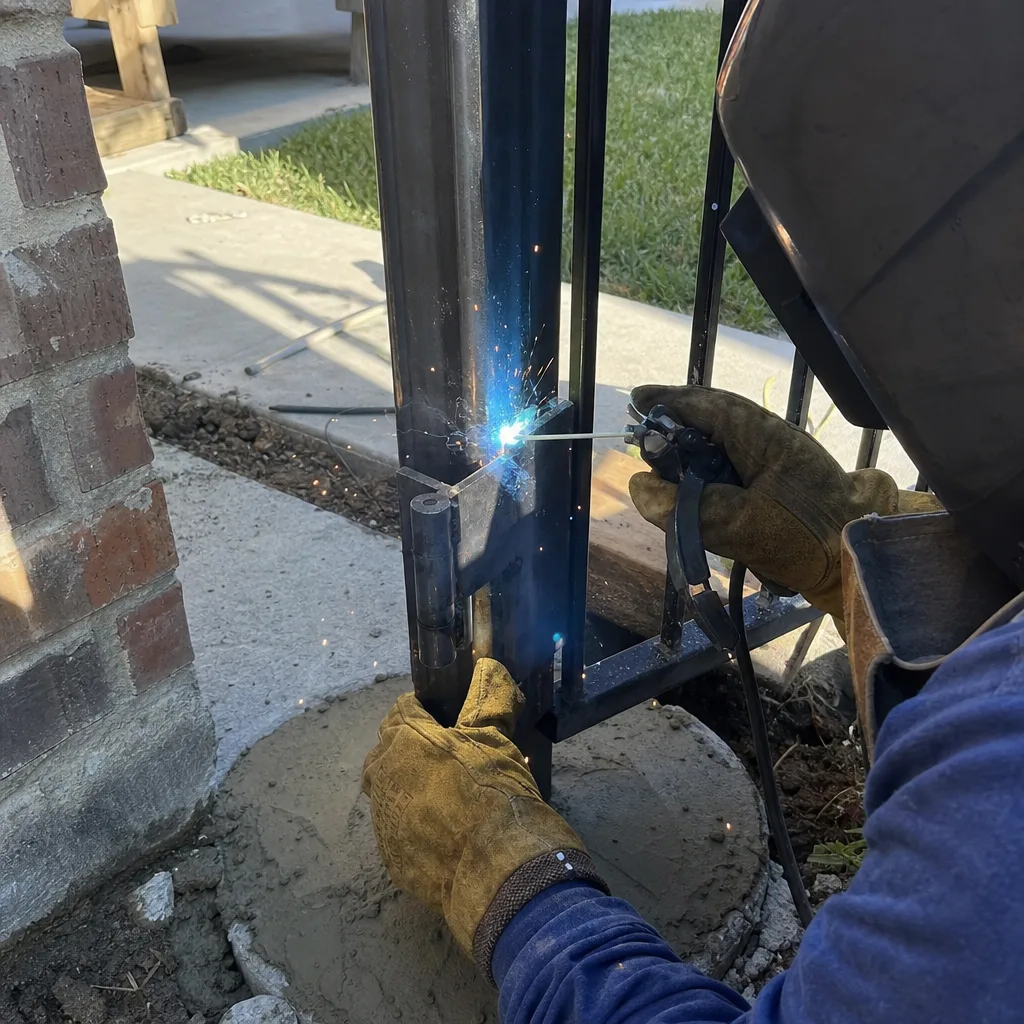
The financial argument for early intervention is straightforward. A capacitor replacement on a LiftMaster or FAAC operator typically runs $150-$250 in Pearland. A full operator replacement, which is what a seized motor or a fried board requires, runs $800-$1,800 depending on the brand and model. Waiting on a warning sign doesn’t save money; it changes the job category.
Repair Cost Ladder: Early vs. Late
- Dry, noisy hinge: catch it early, it’s a lubrication and adjustment call, typically $85-$150. Ignore it, the bearing seizes, the hinge wears oblong, and the gate racks. That’s a hinge replacement with potential welding, typically $300-$600.
- Limit switch drift: catch it early, it’s a reset and repositioning, typically $100-$175. Ignore it, the gate repeatedly overdrives the physical stop, the gearbox takes shock load, and you’re into motor or gearbox work at $500-$1,200.
- Condensation inside the housing: catch it early, it’s a gasket, desiccant, and contact cleaning, typically $120-$200. Ignore it, the board corrodes and shorts. A replacement control board for most residential operators runs $250-$600, plus labor.
Every one of our 22,000+ gate repairs since 2014 has had a written price delivered before the work started and a documented record when the technician left. That means the numbers above are real ranges we’ve quoted in Pearland, not national averages. Your specific gate, brand, and condition determine your exact price, and you’ll have that price in writing before you approve the work. That’s Haven Standard Clause 1, and it applies to every job we do.
If you’re researching Vance Gate Repair Pearland home and comparing service providers, the cost ladder above is the most useful tool you can take into any repair conversation. It tells you whether a quoted price reflects the early fix or the late fix.
Common Mistakes to Avoid
- Ignoring the hesitation because the gate “still works.” Hesitation is the most commonly ignored warning sign we see in Pearland. The gate still opens and closes, so the homeowner rationalizes the delay as normal aging. It’s a failing start capacitor or transformer, and it will fail fully. The repair is cheaper now than after failure.
- Lubricating a noisy gate without identifying the noise source. Spraying lubricant on a gate with a failing bearing temporarily quiets the symptom and permanently hides the diagnosis. The bearing keeps wearing, now with a false sense of security.
- Adjusting the photo-eye without checking alignment first. Pearland homeowners sometimes nudge the photo-eye beam to stop a reversal problem. This can mask an underlying board issue or physical obstruction. The reversal is the symptom, not the disease.
- Assuming rust staining is cosmetic. We covered this above, but it bears repeating: rust staining at a post base in Pearland’s clay soil means structural metal loss. Painting over it is hiding evidence, not solving the problem.
- Waiting until the gate is stuck open or closed before calling. A gate that fails fully leaves you with either no security or no driveway access. The repair is now urgent, you’re paying emergency rates, and the neglect can compound the mechanical damage. Document the warning sign and call when it’s still a scheduled repair.
- Hiring based on verbal estimates alone. A verbal quote isn’t a quote. It’s a guess that can change once the technician opens the housing. A written price, delivered before work starts, is the only thing that protects you from a surprise invoice. Ask for it. If the company won’t provide one, that’s a signal about how the rest of the job will go.
- Replacing the operator before checking the gate itself. We’ve seen Pearland homeowners buy a new operator to solve a slow-travel problem that was actually a swollen post or a dragging hinge. The new operator fails the same way because the mechanical resistance was never addressed. Diagnose first, buy second.
When to Call a Professional

Call a professional when the symptom is in Tier One (grinding, random reversal, burning smell), when you’ve documented a symptom and it’s worsening, or when you’re simply not sure what you’re looking at. A trained technician can assess mechanical versus electrical causes in one visit and give you a written price before any work starts. Gates store significant energy in their operators, springs, and counterweights. High-tension components can release suddenly if handled incorrectly. Don’t attempt to disassemble an operator or adjust a spring yourself. Vance Gate Repair Pearland offers free estimates in Pearland, and a live person answers the phone 24/7 at (346) 253-3225. We’ll tell you whether the symptom you’re seeing is urgent or schedulable, and we’ll put the price in writing before we touch a tool.
Frequently Asked Questions
Most gate repairs in Pearland run between $100 and $600, depending on whether it’s a limit switch adjustment, a capacitor replacement, a hinge repair, or a board swap. Full operator replacements run $800 to $1,800. Your exact price is quoted in writing before any work starts, and the estimate is free. Call (346) 253-3225 for a specific figure on your gate.
Yes, for emergency situations like a gate stuck open, stuck closed, or showing electrical warning signs, same-day service is available in Pearland. A live person answers the phone 24 hours a day, seven days a week, so you’ll speak to a human immediately, not a voicemail queue.
Grinding, scraping, or metallic squealing during gate travel is always serious. It indicates mechanical wear in the gearbox, a failing bearing, or a stretched chain. Occasional creaking at the hinges may be a simpler lubrication issue, but grinding from the operator housing is a gear failure in progress and should be addressed within 48 hours.
The most common causes are a misaligned photo-eye (the infrared beam that stops the gate when something crosses the path), an over-sensitive current-sensing circuit on the control board, or a physical obstruction dragging against the gate’s travel. If the reversal happens at the same point every time, look for a physical obstruction first. At random points, the issue is electrical.
We service nine major gate-automation brands including LiftMaster, FAAC, BFT, and Linear, alongside others. Whatever motor is already on your Pearland property, we’ll repair it rather than steering you toward a replacement you don’t need. Every repair includes a photographed record of what was found and what was set.
Photograph the rust staining, note whether it’s weeping from the post base or surface-level, and call for an assessment. In Pearland’s clay soil, rust weeping from a post base indicates water infiltration and internal metal loss. The structural integrity of the post is the question, and it’s better answered by a professional with welding equipment than by a homeowner with a wire brush.
The Bottom Line
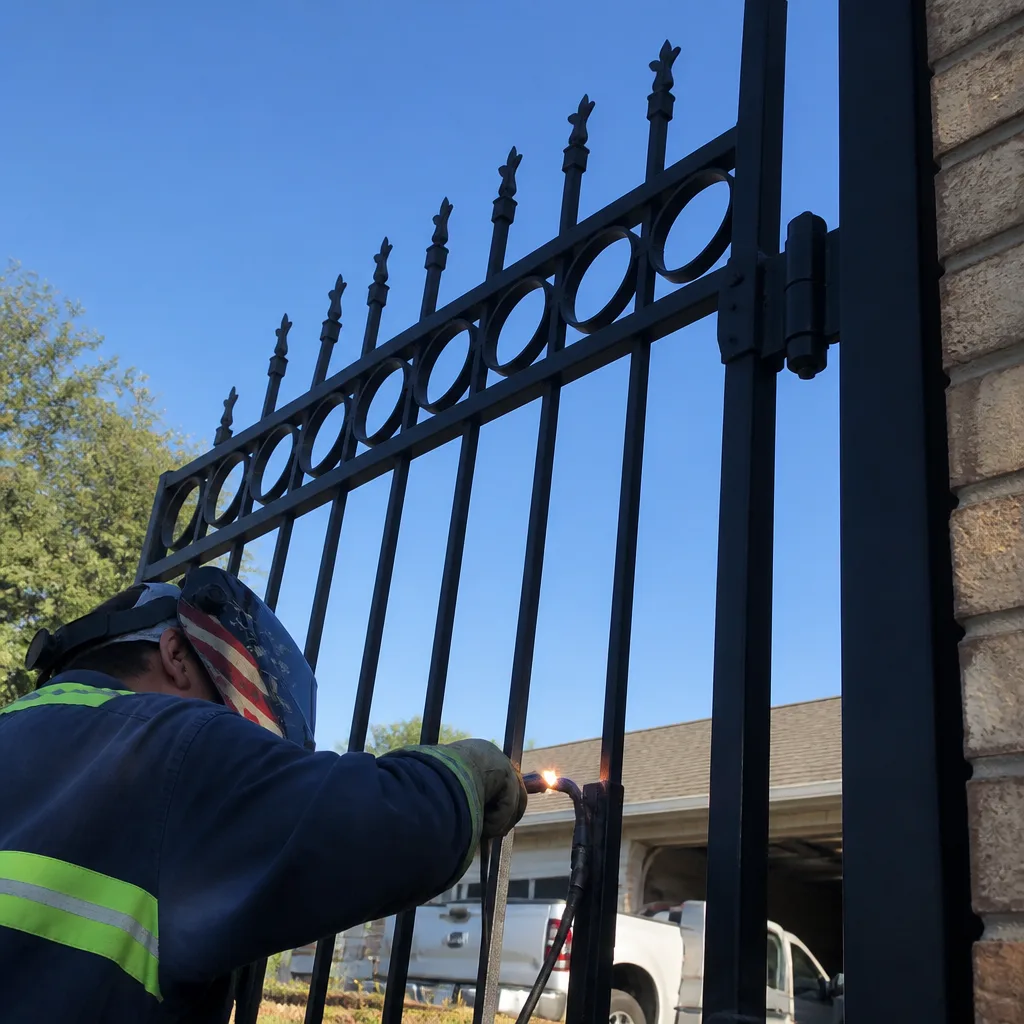
Gate failures in Pearland announce themselves in advance. Grinding noise means gear wear. Hesitation means a failing capacitor or transformer. Reversal means a misaligned photo-eye or board issue. Slow operation means mechanical resistance. Partial opening means limit switch drift. Each symptom maps to a specific cause, and each has an urgency window. Document what you see, photograph it, and call while the repair is a $200 fix instead of a $1,800 replacement. For more guides & resources, see our blog. Every Vance Gate Repair visit ends with a written price before work starts and a documented photo record when the technician leaves. That’s The Haven Standard, and it’s how we’ve handled every gate in Pearland since 2014.
Written by Adrian Vance, Owner at Vance Gate Repair Pearland, serving Pearland since 2014.